

Jul 16,2026
By:Amptfe
The global large-scale deployment of 5G communication infrastructure has brought revolutionary upgrades to mobile communication frequency bands, signal transmission capacity, and equipment operating environments. Sub-6GHz mid-band and millimeter-wave (mmWave) high-band 5G networks put forward unprecedented harsh standards for dielectric insulation materials used in base stations, antenna arrays, RF feeder systems, filter cavities, and remote radio units (RRU). The core performance indicator restricting 5G equipment transmission efficiency is dielectric dissipation factor: materials with high loss tangent will generate massive signal energy waste during high-frequency electromagnetic wave propagation, reduce coverage distance of base station signals, increase equipment power consumption, and distort high-speed data stream waveforms. High-performance polytetrafluoroethylene (PTFE) with ultra-low dissipation factor has become the designated core dielectric material for full-scenario 5G infrastructure construction, thanks to its stable dielectric constant, wide temperature adaptability, weather resistance, and anti-corrosion properties. Our enterprise, a professional PTFE manufacturer with 18 years of production experience, supplies complete 5G supporting PTFE components including PTFE SHEET, insulating tubes, molded gaskets, and precision machined dielectric blocks, exporting products to over 60 countries and regions to support global 5G base station construction and communication equipment manufacturing projects.
5G infrastructure equipment operates in complex outdoor and indoor environments for 24/7 continuous service, combining multiple harsh interference factors: wide-range temperature fluctuation from -40°C to 75°C, long-term solar ultraviolet irradiation, acid rain corrosion, high humidity coastal salt fog, and continuous high-frequency electromagnetic field excitation. Conventional dielectric materials such as FR4 circuit boards, PE insulating tubes, and rubber gaskets suffer from severe performance degradation under such working conditions. FR4 glass fiber boards have a dissipation factor above 0.01 at 28GHz millimeter wave band, causing over 20% signal energy loss during transmission; ordinary polyethylene’s DF rises sharply at frequencies exceeding 3GHz, while rubber insulation materials age rapidly under UV radiation, leading to dielectric parameter drift within 1–2 years. High-purity virgin PTFE solves all these pain points simultaneously: its dissipation factor maintains a stable value below 0.0002 across the full 5G frequency spectrum (0.45GHz–40GHz), with no obvious increase even under long-term high-temperature aging or salt fog immersion. The symmetrical fluorocarbon molecular structure eliminates polar groups inside the material, so dipole loss that dominates high-frequency energy consumption does not occur. When used as antenna substrate dielectric, RF cable inner insulation, and filter cavity lining, low-DF PTFE minimizes insertion loss of 5G radio frequency signals, effectively extending the effective coverage radius of each base station and lowering the overall energy consumption of communication operators’ infrastructure networks.
Key application modules of low-dissipation high-performance PTFE in 5G infrastructure cover the entire industrial chain from base station core equipment to terminal radio frequency accessories. First, millimeter-wave antenna arrays for macro base stations and small cell units rely on thin skived PTFE sheets as dielectric substrates between antenna copper traces. Uniform low DF distribution across the PTFE sheet ensures consistent signal radiation intensity of each antenna unit, avoiding coverage blind spots caused by uneven dielectric loss. Second, RF feeder cables connecting RRU and antenna adopt PTFE TUBE as the inner insulating dielectric layer. Extruded seamless PTFE tubes feature uniform wall thickness and stable Dk value, which precisely controls transmission line impedance at 50Ω or 75Ω, eliminating signal reflection and standing wave interference common in low-quality insulating tubes. Third, 5G cavity filters and duplexers use molded PTFE dielectric blocks and isolation gaskets to separate different frequency band signals; low-loss PTFE reduces cross-band crosstalk and improves filter out-of-band suppression performance, guaranteeing clear separation of uplink and downlink 5G signal channels. In addition, outdoor base station cabinet sealing gaskets, heat insulation isolation pads, and lightning protection wire insulation sleeves all adopt modified low-dissipation PTFE products, balancing mechanical sealing performance and high-frequency dielectric stability for long-term outdoor deployment.
Different 5G application scenarios require targeted optimized PTFE material formulas and processing technologies to retain ultra-low dissipation factor while enhancing mechanical and environmental adaptability. For millimeter-wave antenna ultra-thin substrates, we adopt high-precision skiving technology to produce PTFE sheets with thickness ranging from 0.05mm to 2mm, controlling thickness tolerance within ±0.01mm to avoid local impedance mutation. Expanded PTFE (ePTFE) sheets with microcellular structures are customized for flexible 5G microstrip antennas; internal air pores reduce the material’s equivalent dielectric constant and further cut down dissipation loss, making flexible antenna design lighter and more efficient. For high-strength structural dielectric parts inside filter cavities, low-content inert glass microspheres are blended into PTFE resin to boost compressive modulus without introducing conductive impurities that raise DF. All modified formulas strictly exclude carbon powder, graphite, and metal fillers, which would form conductive leakage paths and drastically amplify high-frequency loss tangent. Our automated production workshop equipped with 24 independent production patents implements full-process impurity control: raw material vacuum degassing, dust-free molding, and non-metal cutting tools prevent metal contamination, ensuring finished PTFE products maintain ultra-low DF required by 5G RF design specifications.
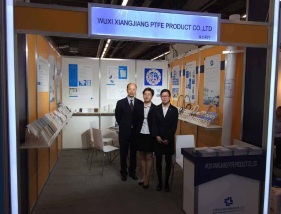
Quality certification and large-scale delivery capacity support mass adoption of low-loss PTFE in global 5G infrastructure construction. Our full line of PTFE dielectric materials has passed ISO9001-2000 quality system certification and SGS environmental testing, with independent high-frequency dielectric parameter testing laboratory equipped with vector network analyzers covering 0.1GHz–50GHz frequency bands. Every batch of PTFE sheets, tubes, and molded gaskets is tested for dissipation factor, dielectric constant, dimensional stability, and anti-aging performance, providing complete test reports for communication equipment manufacturers. With 30+ skilled production workers and annual export volume exceeding 2200 tons, we can stably supply large communication equipment manufacturers in Europe, Southeast Asia, and North America, and have participated in international industry exhibitions including ACHEMA 2024 in Germany and CSEAC 2023 semiconductor electronics show to communicate 5G PTFE material optimization solutions with global industry clients. Our technical team provides free customized material formula consultation and sample trial production services for base station antenna, RF cable, and filter manufacturers, adjusting PTFE density, thickness, and filler ratio according to client frequency band and environmental usage requirements to achieve optimal balance between low dissipation factor, mechanical strength, and cost control.
Looking ahead to 5G-A and 6G communication technology iteration, operating frequency bands will expand to higher millimeter-wave and sub-terahertz ranges, and the threshold for dielectric material low-loss performance will be further raised. High-performance low-dissipation PTFE will remain the irreplaceable core dielectric material for next-generation communication infrastructure, as no other existing polymer material can match its ultra-stable DF across ultra-wide frequency bands and extreme working environments. Our company will continue to increase investment in low-loss PTFE composite material R&D, upgrade precision skiving and seamless tube extrusion equipment, and develop lighter, thinner, more weather-resistant PTFE dielectric products to meet the growing demand of global 5G and future communication infrastructure construction. By combining stable material performance, mature mass production capacity, and professional one-stop customized service, we aim to reduce signal transmission loss of global 5G base station equipment, lower operator operating costs, and accelerate the popularization of high-speed, low-latency 5G communication networks worldwide.

Hi! Welcome back.
How are you doing?
We always adheres to the professional, attentive, focused environmental protection filtration, and is a worthy partner in the filtration industry.
Amptfe is a world-class PTFE pipe, rod, and material solution manufacturer certified by ISO 9001:2015.
Tel: +86 1-815-110-6156
E-mail:ptfe@amptfe.com
Add:Room 4010-1, Building B, No.68 North Dongting Road, Dongbeitang Sub-district, Xishan District,Wuxi,Jiangsu
Copyright © 2024 Ltd All Rights Reserved.