

Jul 16,2026
By:Amptfe
Radio frequency (RF) and microwave electronic systems operate across frequency bands from 300 kHz up to 110 GHz, covering wireless communication, radar detection, satellite navigation, medical imaging, industrial microwave sensing, and aerospace telemetry equipment. The core technical bottleneck restricting RF/microwave system performance is dielectric signal loss caused by substrate and insulating materials, measured quantitatively by the dissipation factor (loss tangent). Materials with high DF values absorb massive electromagnetic energy during signal transmission, resulting in weak output power, distorted signal phase, narrow bandwidth, and shortened device service life. Ultra-low dissipation factor polytetrafluoroethylene (PTFE) materials resolve these pain points fundamentally, forming a complete material ecosystem including PTFE SHEET substrates, PTFE TUBE coaxial insulation, molded PTFE blocks, skived thin films, custom PTFE gaskets and machined PTFE articles exclusively engineered for RF and microwave industrial scenarios. Certified by ISO9001-2000 quality management systems and SGS material safety standards, industrial-grade ultra-low loss PTFE materials deliver consistent dielectric performance under extreme working conditions, becoming the mainstream dielectric choice for high-end RF and microwave hardware manufacturing worldwide.
To fully recognize the superiority of PTFE in RF and microwave frequency bands, comparative dielectric testing across mainstream substrate materials reveals an obvious performance gap. Standard FR-4 glass epoxy circuit boards, widely used in low-frequency electronics, show a dissipation factor of 0.018–0.022 at 2.4 GHz; when frequency rises to 10 GHz, DF surges above 0.03, making it completely unsuitable for microwave equipment. Modified polyimide high-frequency materials maintain DF around 0.003 at 5 GHz, but their strong water absorption rate of over 1.5% triggers severe loss drift in humid marine or outdoor communication environments. LCP liquid crystal polymers achieve low DF close to PTFE, yet suffer from high raw material costs, narrow molding temperature windows, and poor machinability for complex microwave structural components.
In contrast, virgin ultra-low dissipation factor PTFE materials record a loss tangent of 0.00015–0.00022 across 1 GHz to 110 GHz microwave bands, with Dk (dielectric constant) fixed at 2.1, the lowest stable dielectric constant among all solid industrial polymers. Ceramic-filled composite PTFE variants adjust Dk from 2.2 to 9.8 for customized microwave impedance matching, while controlling DF below 0.0009 without sacrificing low-loss characteristics. PTFE SHEET products include two core categories: skived PTFE thin sheets for flexible microwave circuits and molded PTFE thick sheets for rigid high-power microwave baseplates. Both variants retain ultra-low DF performance with thickness tolerance controlled within ±0.003 mm, guaranteeing uniform impedance distribution across microwave microstrip, stripline, and coplanar waveguide structures. Complementarily, extruded seamless PTFE TUBE serves as the dielectric core of semi-rigid and flexible RF coaxial cables, isolating inner and outer conductors to minimize leakage loss and crosstalk in microwave signal transmission lines.
Beyond ultra-low dissipation factor, PTFE’s comprehensive physical and chemical stability extends the service life and reliability of RF and microwave devices in complex operating environments, a critical advantage for outdoor, aerospace, and industrial microwave equipment. First, PTFE exhibits outstanding temperature resistance, with continuous working temperature ranging from -200°C to 260°C. Microwave radar systems mounted on aircraft, ships, and new energy vehicles experience drastic temperature swings from low-altitude freezing to high-temperature engine radiation; ultra-low DF PTFE substrates and tubular insulation maintain unchanged Dk and DF parameters without thermal deformation or performance attenuation, unlike resin-based materials that soften and lose dielectric stability above 120°C.
Second, PTFE features absolute chemical inertness, resisting corrosion by strong acids, alkalis, organic solvents, salt fog, and industrial volatile gases. Marine microwave communication transceivers, chemical plant microwave monitoring sensors, and petroleum pipeline RF detection equipment operate in corrosive atmospheres; ordinary polymer dielectrics gradually erode, forming surface defects that amplify microwave loss, while PTFE sheets, tubes, and gaskets remain intact for decades of continuous operation. Third, the near-zero water absorption rate (≤0.01%) eliminates moisture-induced dielectric loss fluctuations. Humidity is a major interference factor for microwave signal precision: water molecules possess strong dipole polarization properties, which sharply raise the effective dissipation factor of damp substrates. PTFE’s non-polar fluorinated molecular surface repels water completely, ensuring consistent microwave transmission performance in tropical high-humidity coastal base stations and underground industrial microwave monitoring rooms.
Low friction and excellent machinability further expand PTFE’s application scope in precision microwave component manufacturing. Manufacturers utilize automated PTFE production equipment with 24 independent innovation patents to process custom complex microwave structural parts, including flanged PTFE gaskets, hollow insulating sleeves, stepped PTFE tubes, multi-layer microwave support spacers, and precision machined PTFE articles. These custom components eliminate parasitic capacitance and stray inductance inside microwave filters, power dividers, circulators, and antenna feeders, preserving the ultra-low DF advantage of the entire microwave system rather than only individual substrate materials.
5G macro base stations, millimeter-wave small cell antennas, and upcoming 6G test communication systems constitute the largest consumer market for ultra-low loss PTFE materials. Microwave backhaul transmission boards, phased array antenna substrates, RF filter circuit plates, and power amplifier isolation components all adopt skived or molded PTFE SHEET as core dielectric substrates. Thin-wall low-DF PTFE tubes are used as insulation for feeder coaxial cables connecting base station transceivers to external antenna arrays, reducing signal attenuation during long-distance microwave transmission. By cutting transmission loss by over 90% compared with traditional high-loss substrates, PTFE materials lower base station power consumption, expand signal coverage radius, and improve communication bandwidth capacity for 24 GHz, 28 GHz, and 39 GHz millimeter-wave communication bands.
Aerospace and military radar equipment sets the strictest standard for ultra-low dissipation factor PTFE performance. Satellite Ka/Ku-band communication transponders, airborne early warning radar, ship-borne phased array radar, and missile guidance microwave modules rely entirely on virgin unfilled PTFE sheets and precision extruded PTFE tubes. In satellite on-orbit environments combining vacuum, extreme temperature cycling, and cosmic radiation, PTFE retains stable low-loss dielectric properties without radiation aging, which would cause DF degradation in alternative polymer materials. Custom machined PTFE gaskets and insulating articles seal microwave radar cavity structures, preventing electromagnetic leakage and maintaining consistent resonant frequency for radar signal processing circuits.
Autonomous driving 24 GHz blind spot detection radar and 77 GHz long-distance forward radar demand ultra-low DF microwave substrates to guarantee high-precision target distance and velocity detection. Modified ceramic-filled PTFE molded sheets with tuned dielectric constants miniaturize radar circuit board size to fit compact vehicle internal installation spaces, while low-loss performance eliminates signal distortion caused by vehicle engine thermal interference. Miniature thin-walled PTFE tubes insulate internal microwave wiring inside radar sensor housings, resisting vibration and temperature fluctuations during vehicle driving without loss performance drift.
Industrial microwave heating, microwave nondestructive testing, and medical MRI RF coils rely on ultra-low DF PTFE insulation materials. Microwave chemical reaction monitoring sensors deployed in chemical, textile, and petroleum factories use PTFE insulated signal lines to resist corrosive industrial fumes. Medical magnetic resonance imaging equipment applies thin skived PTFE sheets as RF coil dielectric substrates; low dissipation factor reduces background noise in imaging signals, improving medical scan clarity and diagnostic accuracy.
Professional PTFE manufacturers with 18 years of filter and fluoropolymer production experience build full industrial chains covering raw material molding, skiving, extrusion, precision CNC machining, and quality inspection to supply stable ultra-low DF PTFE products for global RF and microwave enterprises. The production workshop is equipped with dedicated automation PTFE forming equipment, controlling molecular uniformity of raw PTFE resin to avoid internal defects that would create local high-loss regions in finished sheets and tubes. Every batch of PTFE SHEET and PTFE TUBE undergoes strict dielectric testing at 1 GHz, 10 GHz, and 77 GHz microwave frequency bands to verify dissipation factor consistency, with test reports provided alongside SGS and ISO9001 certification documents.
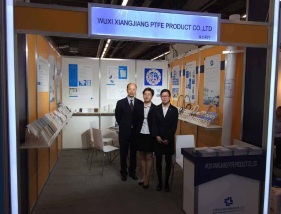
The enterprise’s sales network covers more than 60 countries and regions, with annual export volume exceeding 2200 batches of PTFE microwave materials. The team regularly participates in global industry exhibitions including ACHEMA 2024 Frankfurt Process Industry Fair, PTC ASIA Shanghai Power Transmission Exhibition, and CSEAC Semiconductor Equipment Exhibition, communicating technical updates on ultra-low DF PTFE composite materials with RF/microwave design engineers worldwide. A professional technical team of over 30 skilled technicians provides customized material solution services, adjusting PTFE filling ratios, sheet thickness, tube inner/outer diameters, and machined part structures to match unique microwave circuit impedance, power, and environmental resistance requirements of each customer’s project.
The advancement of terahertz microwave imaging, 6G ultra-wideband communication, deep-space exploration radar, and high-precision industrial microwave sensing puts forward higher requirements for PTFE dielectric loss performance. Current R&D focuses on two core directions: nano-filler homogenization modification and ultra-thin uniform skiving technology. Nano-sized fluorocarbon and silicon oxide fillers dispersed at molecular levels further reduce PTFE’s high-frequency dissipation factor below 0.0001 at millimeter-wave bands, while ultra-thin PTFE sheets thinner than 0.008 mm support flexible wearable microwave RF devices. Meanwhile, reinforced composite PTFE materials combining glass fiber and ceramic powder improve mechanical tensile strength without sacrificing low-loss performance, expanding PTFE’s application in high-power microwave transmission hardware.
Continuous innovation in automated extrusion and molding equipment optimizes the dimensional precision of micro-diameter microwave-grade PTFE TUBE, catering to miniaturized chip-scale microwave circuit interconnection demands. New expanded PTFE thin gasket sheets with ultra-low DF are developed for microwave module sealing, replacing composite rubber gaskets that introduce high dielectric loss at high frequencies. As global RF and microwave technology enters a high-frequency, high-power, miniaturization development cycle, ultra-low dissipation factor PTFE material systems will remain the irreplaceable foundational dielectric solution, continuously driving the performance upgrade of all categories of RF and microwave electronic equipment across aerospace, communication, automotive, medical, and industrial manufacturing sectors.

Hi! Welcome back.
How are you doing?
We always adheres to the professional, attentive, focused environmental protection filtration, and is a worthy partner in the filtration industry.
Amptfe is a world-class PTFE pipe, rod, and material solution manufacturer certified by ISO 9001:2015.
Tel: +86 1-815-110-6156
E-mail:ptfe@amptfe.com
Add:Room 4010-1, Building B, No.68 North Dongting Road, Dongbeitang Sub-district, Xishan District,Wuxi,Jiangsu
Copyright © 2024 Ltd All Rights Reserved.